- Industries
- Styles
- Materials
- Hot Selling
- Categories
- Design Services
- Company
- United States

Quick answer: To measure a box, open it and measure in this order: length (the longer side of the opening), width (the shorter side of the opening) and depth (from the opening to the bottom). Write it as L × W × D. Custom box makers use inside dimensions so the product fits. Carriers use outside dimensions to price shipping.
Knowing how to measure a box correctly saves you from the most expensive mistake in custom packaging: a whole run of boxes that are a little too tight or a little too loose. It takes one tape measure and one simple rule: box dimensions always follow the same order.
This guide covers the L × W × D order, inside vs. outside dimensions, sizing a box around your product, each box style, and how to measure a box for shipping.
In this guide
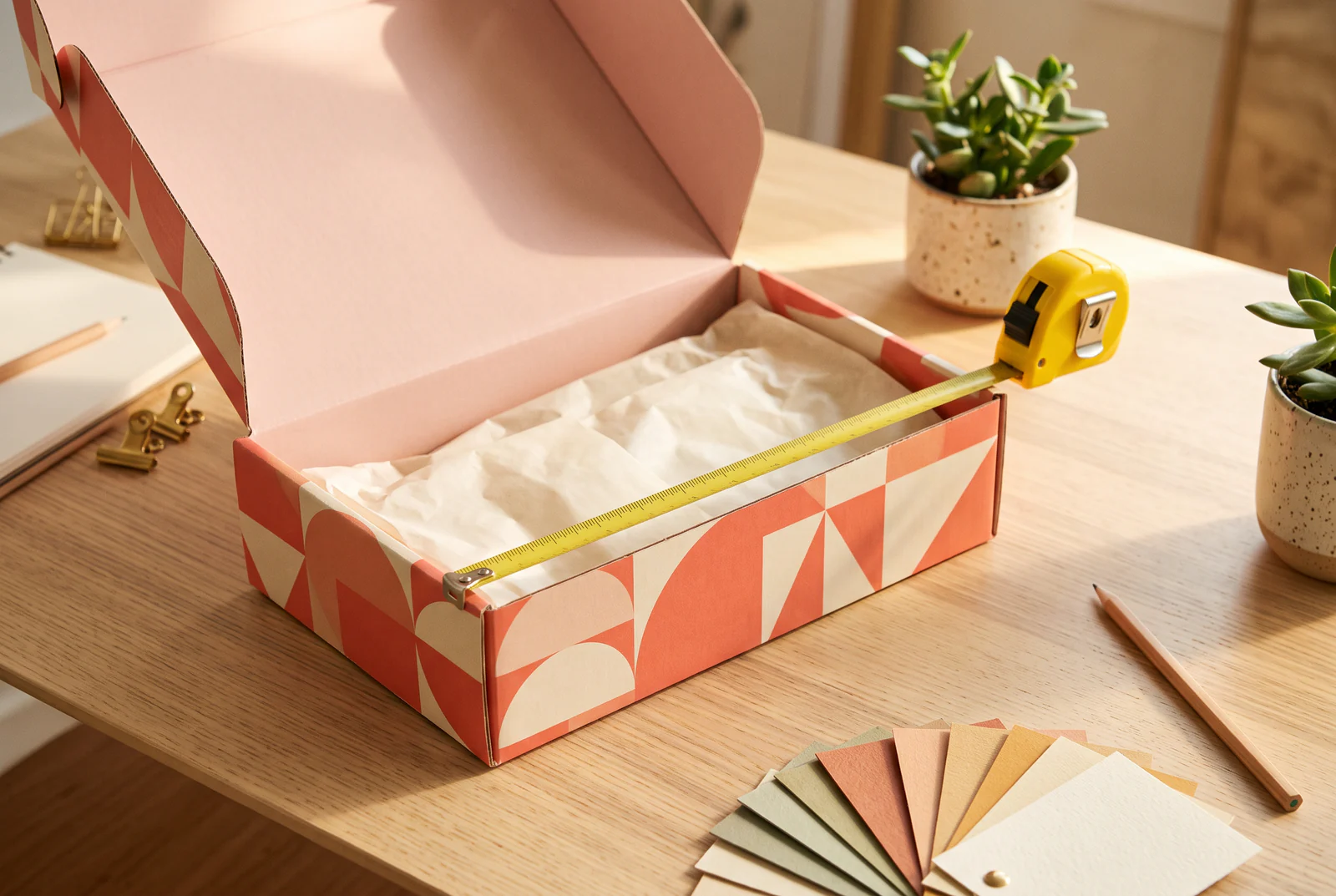
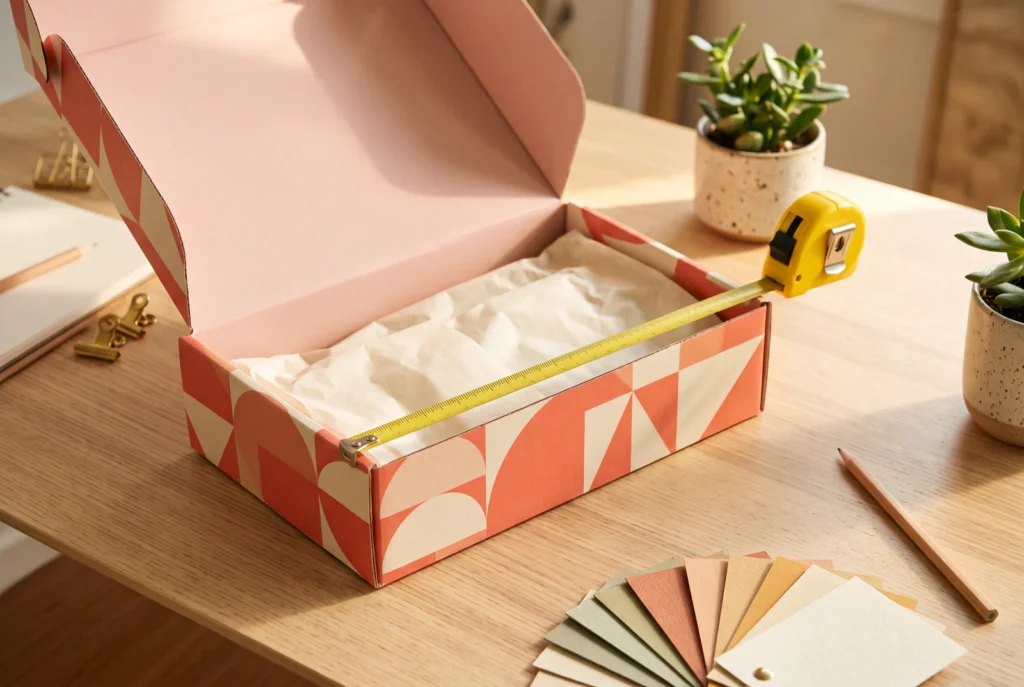
You measure a box in three steps: length, then width, then depth, all taken at the opening. Use a stiff tape measure or ruler and measure in inches, the standard unit for box sizes in the US.
Measure along the edges where panels meet, not across a bulging panel, and open a closed box first so a flap does not hide part of the depth.
Length comes first, then width, then height (depth). This is the standard order for box dimensions and the one box makers expect on a quote request.
The key detail is that length and width are always the two sides of the opening. Height is never decided by which number is biggest. A tall, narrow carton for a bottle might be 2 × 2 × 7 in: the opening is 2 in by 2 in, and the box is 7 in deep. Written as 7 × 2 × 2, it could be read as a long, flat box that opens on the wide side.
L x W x H means length × width × height, written in that order. On a box, height and depth mean the same thing: the distance from the opening to the bottom. You will see both L × W × H and L × W × D used for box dimensions.
Here is how to read a few examples:
If someone gives you three numbers without saying which is which, ask before you order. The same three numbers in a different order describe a different box.
For ordering custom boxes, use inside dimensions. For shipping and storage, use outside dimensions. The difference is the thickness of the board on each side.
Custom box makers quote inside dimensions because the inside is what has to fit your product. The outside size changes with the material: thicker board, such as double-wall corrugated, adds more on every wall than thin paperboard. When we build a dieline, we start from your inside size and allow for the board.
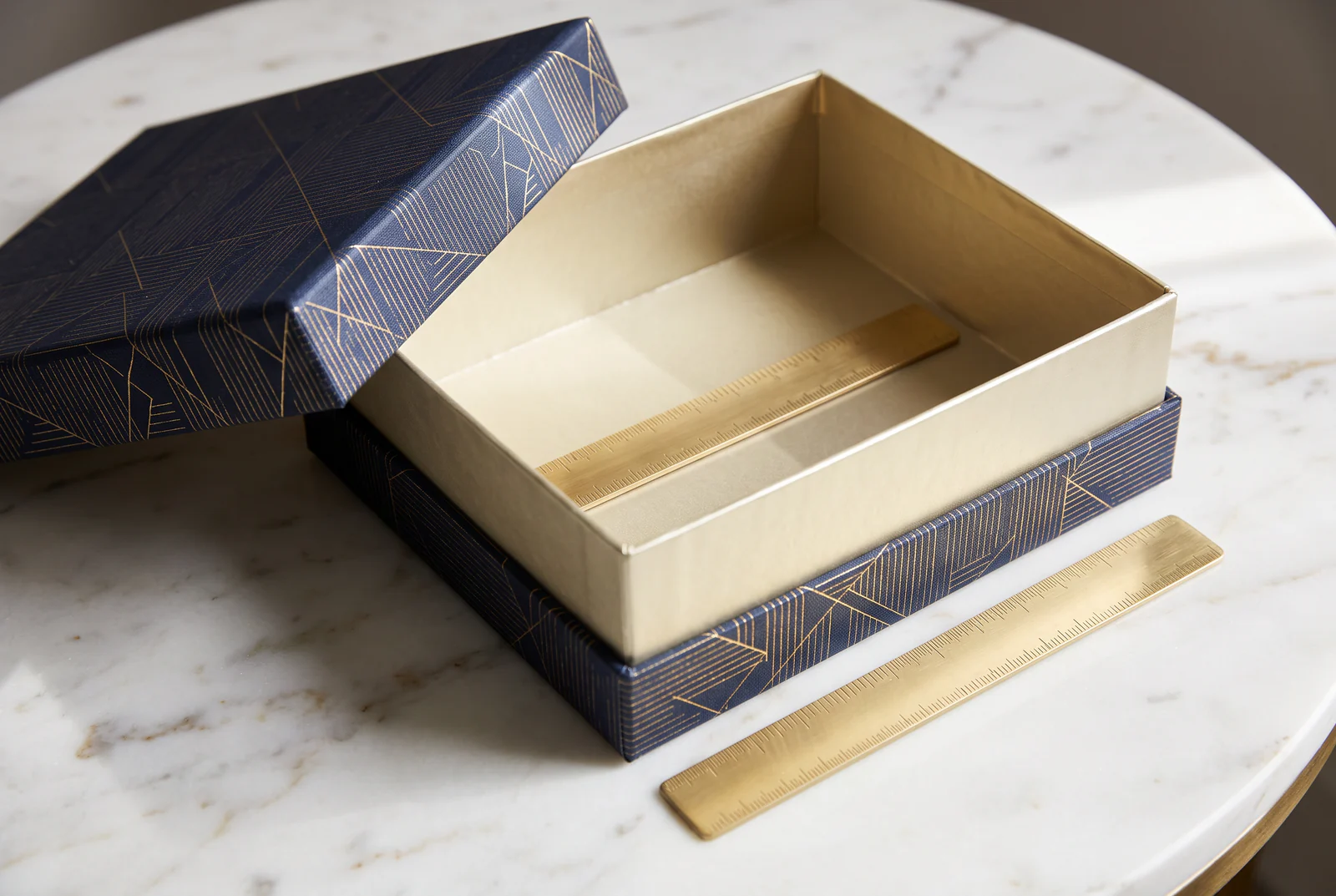
Measure the product at its widest, longest and tallest points, then add a little clearance so it slides in and out without forcing. That gives you the inside size of the box.
For a gift set, lay the items out the way they will sit, measure the whole group, and send us both the group size and each item size.

The L × W × D rule stays the same for every style. What changes is where the opening is, so the depth can point in a different direction.
A mailer box opens from the top with a hinged lid. Length and width are the floor of the box seen from above, and depth is the inside height from the floor to the closed lid. Depth is often the smallest number.
A tuck-end box opens at the small ends, where the tuck flaps are. Length and width are the sides of that end opening, and depth runs from the top flap to the bottom flap. That is why tuck-end boxes often have the biggest number last. Not sure which style you need? Our guide on mailer boxes vs. tuck-end boxes compares them.
A rigid two-piece box has a separate base and lid. Measure the inside of the base: length and width of the floor, then the inside depth of the base. The lid is made slightly larger to slide over the base. Rigid boxes ship to you assembled, so plan storage with the outside size.
A standard corrugated box opens at the top with four flaps. Length and width are the sides of the top opening, and depth is the inside height up to where the flaps fold. For the carrier, you will need the outside size of the closed, packed box.
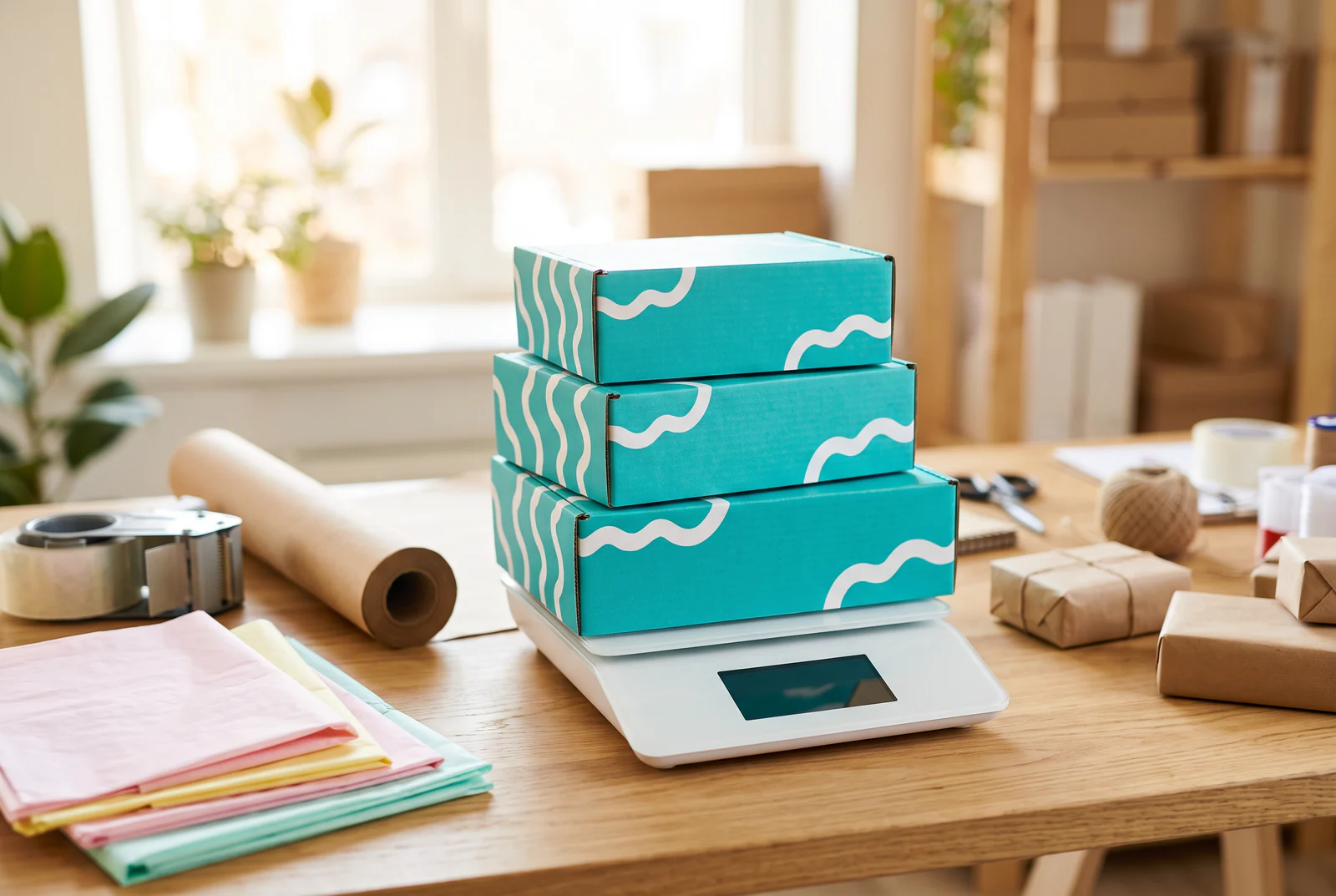
To measure a box for shipping, pack and seal it first, then measure the outside length, width and height. Carriers price parcels using the outside size, because that is the space the box takes up in a truck or plane.
Most major carriers charge by the greater of the package’s actual weight or its dimensional weight, a figure worked out from the box’s outside size. The carrier multiplies length × width × height and divides by a number it sets. A light product in a large box can be billed as if it were much heavier.
Each carrier sets its own divisor and rounding rules, so check your carrier’s current rates. The lesson is the same everywhere: a box sized closely to your product usually costs less to ship than one with lots of empty space.
Here is how to measure a box for four common products. The sizes are examples of the order and direction of each measurement, not standard sizes.
| Product | Box style | Where the opening is | Inside size (L × W × D) | What to note |
|---|---|---|---|---|
| Folded T-shirt | Mailer box | Top (hinged lid) | 10 × 8 × 2 in | Shallow box; depth is the smallest number |
| Serum bottle with dropper | Tuck-end box | Small end (tuck flap) | 1.75 × 1.75 × 5 in | Tall box; depth is the largest number |
| Watch on a card insert | Rigid two-piece box | Top (lift-off lid) | 5 × 5 × 3 in (base) | Size includes room for the insert; lid is made to fit over the base |
| Six product cartons | Corrugated shipping box | Top (four flaps) | 12 × 8 × 6 in | Measure the cartons as a group; use outside size for the carrier |
There is no single standard box size, but many everyday boxes fall into familiar ranges. The chart below shows typical inside dimensions in L × W × H order, using the opening as length and width. Brands vary, so treat these as a starting point and always measure your own product.

| Box | Where it opens | Typical size (L × W × H) | Notes |
|---|---|---|---|
| Adult shoe box | Top (lift-off or hinged lid) | about 11–14 × 6–8 × 4–5 in | Boots need a taller, longer box; kids’ shoes a smaller one |
| Cereal box | Top (small end) | about 7–8 × 2–3 × 10–12 in | A tall box: the height is the largest number |
| Tissue box, cube | Top (slot) | about 4.5 × 4.5 × 5 in | The flat version is about 9 × 4.5 × 3.5 in |
| Pizza box | Top (hinged lid) | 10–18 in square × 1.5–2 in | Named after the pie: a 12 in box fits a 12 in pizza |
| Cigarette pack | Top (flip lid) | about 2.2 × 0.9 × 3.5 in (king size) | Slim and tall; 100s are longer |
| 8 oz candle jar box | Top (tuck end) | about 3.5 × 3.5 × 4 in | Depends on the jar; measure with the lid on |
| File storage box (banker’s box) | Top (lift-off lid) | about 15 × 12 × 10 in | Holds letter or legal files |
| Small shipping box | Top (four flaps) | 6 × 6 × 6 in, 8 × 8 × 8 in, 10 × 8 × 6 in | Common stock sizes for small orders |
| Medium and large shipping box | Top (four flaps) | 12 × 12 × 12 in, 16 × 12 × 12 in, 18 × 18 × 18 in | Use outside size for carrier pricing |
A stock size is rarely an exact fit. A box that is too big needs filler and costs more to ship, because carriers charge for space as well as weight. A box made to your product fits closely, looks better and protects the product. Every box we make is cut to your size, whether that is a custom shoe box, a tall cereal box, a tissue box, a pizza box or a plain shipping box.
Most sizing problems come from mixing up the order of dimensions or the inside and outside size.
Once you know how to measure a box, ordering is simple. Send us what you have and we will turn it into an exact box size.
The minimum order is 100 boxes per design and per size, and US orders over $500 ship free. Browse all our box styles on the packaging categories page, or see our custom shipping boxes if your product goes straight into the mail. Food boxes are sized the same way: for custom cake boxes and custom pizza boxes, start from the inside space the food needs.
Open the box and measure the opening’s longer side (length), the opening’s shorter side (width), then the distance from the opening to the bottom (depth). Write it as L × W × D in inches.
Length comes first, then width, then height. Length and width are always the two sides of the opening, so the height can be the largest number on a tall box.
It means length × width × height. Length and width are the two sides of the opening, and height (also called depth) runs from the opening to the bottom. For example, 12 × 10 × 4 in is a box with a 12 in by 10 in opening that is 4 in deep.
There is no single standard, but most adult shoe boxes are about 11–14 in long, 6–8 in wide and 4–5 in high. Boots need a larger box and kids’ shoes a smaller one, so measure the shoes and order a box made to that size.
Give inside dimensions. Custom box makers use the inside size so the product fits, and they allow for the board thickness themselves. Outside dimensions are for shipping and storage.
Pack and seal the box, then measure the outside length, width and height at the longest points and weigh it. Carriers use the outside size to work out dimensional weight.
Leave a small amount of clearance so the product slides in without forcing but does not move around. If you are unsure, send us your product size and we will set the box size on your free dieline.
Yes. Physical samples take 5–7 days, so you can check the fit with your real product. Every order also comes with a free digital proof.
This guide was written by the Pro Packaging Line team, a custom packaging printer based in Dallas, Texas. Learn more about us.
Get in touch — we're happy to send a free first-pass concept for your packaging project.